Showing posts with label Word Wednesday. Show all posts

Tuesday, May 3, 2022

Mom's Church Songbooks (full of photos!)

I will sing to the Lord as long as I live;

I will sing praise to my God while I have my being.

May my praise be pleasing to Him;

As for me, I shall rejoice in the Lord.

Psalm 104:33-34


[[[This post is full of pictures, so grab a cool beverage and take in all this musical goodness!]]]

My grandma played the piano and organ and led congregational singing; my mom mostly led the congregational singing but played the piano for herself.  She also sang whilst playing said piano and convinced me to sing harmony with her.  Some special memories, for sure.

I found some old songbooks my mom had given me before she became incapacitated by aphasia.  Some were hers and some were her mom's.  Look at these covers!  #oldschool


You'll notice Grandma had two of the black/white/green songbooks in the lower right corner.  I can imagine she had one copy kept in the piano bench at church (you know, where you lifted up the piano bench seat and there was storage underneath) and one she kept on her piano in the parsonage.  That book was published in 1943!

Here is the inside cover:


.....

In the upper middle left is a book of grandma's called "One Hundred Hymns and Gospel Songs" by Frank C. Huston published in 1955.  Here are some images of the inside covers:


That dedication above:  I don't have that nose tickle and a throat lump, not at all.


What joy Mr. Huston must have found in leading people in worship!

.....

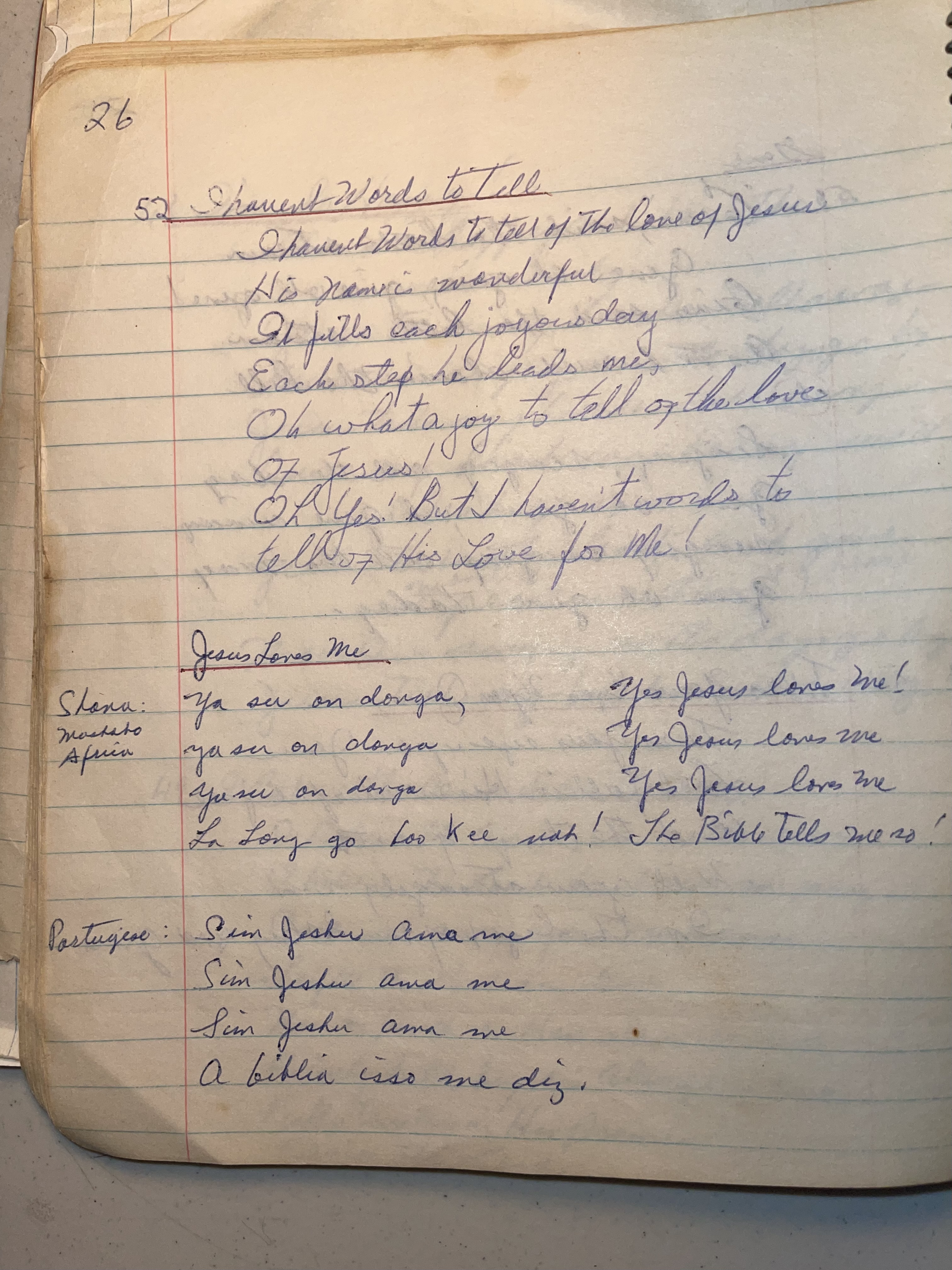
Grandma was a Bullet Journaler!  Okay, not in the sense we know today, but she sure listed out some lyrics in the well-worn composition book you see below.

She had two volumes of these composition books and they were kept together.  So much so that the coils have intertwined with each other and have essentially become one book.  I didn't have the heart to take them apart.


Look at that last picture (above).  She had written out words to "Jesus Loves Me" in two different languages:  Shona and Portuguese.  Grandma and Grandpa were always missions-oriented.  Must be where I get it.

.....

The following booklets are some of the ones my mom had.  They are mostly from the 1970s so you might see some real groovy-ness in these pictures.  Enjoy!  #eyecandy


.....


.....


.....


,,,,,

Some extra special groovy-ness in the booklet below.  We'd think the book was a steal at $1.25 today!  I sure was fascinated by the embroidery pictured on the cover below.  I made sure it was displayed prominently on my mom's piano.  I secretly wanted that embroidery on a pair of jeans--can you blame me?  I don't remember my mom giggling at my girlishness organization or how many times she secretly gave me the ol' SideEye.  #notfarfromthetree


A pic of some groovy 1970s graphics for ya:


Some cool-hair-groovy-ness below:

What conditioner did he use?  Honestly.


Check out that last picture above:  "What?  No guitars where you are? No bass? No drums?  Take heart!  They're as close as your music supplier!"
This book was published in 1971 and churches were moving toward using more instruments besides the piano and organ.  Church music had to change with the times whether we liked it or not.

.....
Please share your memories in the comments; I'd love to hear them!

I know I am very much looking forward to spending the rest of eternity singing with the Saints in that heavenly choir, joining my parents and grandparents and great-grandparents along with these amazing men and women who wrote these songs and compiled these collections.

"We're all walking each other Home."


Wednesday, April 6, 2022

Word Study - Propitiation


Now all these things are from God, who reconciled us to Himself through Christ and gave us the ministry of reconciliation.  2 Corinthians 5:18

Propitiation

See Atonement

that by which God is rendered propitious, i.e., by which it becomes consistent with his character and government to pardon and bless the sinner. The propitiation does not procure his love or make him loving; it only renders it consistent for him to execise his love towards sinners.

In Romans 3:25 and Hebrews 9:5 (A.V., "mercy-seat") the Greek word hilasterion is used. It is the word employed by the LXX. translators in Exodus 25:17 and elsewhere as the equivalent for the Hebrew kapporeth , w
hich means "covering," and is used of the lid of the ark of the covenant ( Exodus 25:21 ; 30:6 ). This Greek word (hilasterion) came to denote not only the mercy-seat or lid of the ark, but also propitation or reconciliation by blood. On the great day of atonement the high priest carried the blood of the sacrifice he offered for all the people within the veil and sprinkled with it the "mercy-seat," and so made propitiation.

In 1 John 2:2 ; 4:10 , Christ is called the "propitiation for our sins." Here a different Greek word is used (hilasmos). Christ is "the propitiation," because by his becoming our substitute and assuming our obligations he expiated our guilt, covered it, by the vicarious punishment which he endured. (Compare Hebrews 2:17 , where the expression "make reconciliation" of the A.V. is more correctly in the RSV "make propitiation.")


Covering; atoning sacrifice.

My little children, these things write I unto you, that ye sin not. And if any man sin, we have an advocate with the Father, Jesus Christ the righteous: and he is the PROPITIATION for our sins: and not for ours only, but also for the sins of the whole world. ( 1 John 2:1 Isaiah 2:1-2 )


Theological Implication:

The basal idea in Hebrew terms is that of covering what is offensive, so restoring friendship, or causing to be kindly disposed. The Greek terms lack the physical reference to covering but introduce the idea of friendliness where antagonism would be natural; hence, graciousness. Naturally, therefore, the idea of expiation entered into the concept. It is especially to be noted that all provisions for this friendly relation as between God and offending man find their initiation and provision in God and are under His direction, but involve the active response of man. All heathen and unworthy conceptions are removed from the Christian notion of propitiation by the fact that God Himself proposed, or "set forth," Christ as the "mercy-seat," and that this is the supreme expression of ultimate love. God had all the while been merciful, friendly, "passing over" man's sins with no apparently adequate, or just, ground for doing so. Now in the blood of Christ sin is condemned and expiated, and God is able to establish and maintain His character for righteousness, while He continues and extends His dealing in gracious love with sinners who exercise faith in Jesus. The propitiation originates with God, not to appease Himself, but to justify Himself in His uniform kindness to men deserving harshness. Compare also as to reconciliation, as in Romans 5:1-112 Corinthians 5:18.

.....

For Further Study

What is Propitiation? Bible Meaning and Definition (biblestudytools.com)

Propitiation - Encyclopedia of The Bible - Bible Gateway

What Does “Propitiation” Mean? Biblical Meaning & Understanding (christianity.com)


Wednesday, February 23, 2022

Word Study - Stronghold

 I will raise my eyes to the mountains; from where will my help come?  My help comes from the Lord, who made heaven and earth.  He will not allow your foot to slip; He who watches over you will not slumber.  Behold, He who watches over Israel will neither slumber nor sleep.  The Lord is your protector, the Lord is your shade on your right hand.  The sun will not beat down on you by day, nor the moon by night.  The Lord will protect you from all evil; He will keep your soul.  The Lord will guard your going out and your coming in from this time and forever.   Psalm 121

The Lord also will be a stronghold for the oppressed, a stronghold in times of trouble.  Psalm 9:9

Bless the Lord, O my soul, and forget not all His benefits, who forgives all your iniquity, who heals all your diseases, who redeems your life from the pit, who crowns you with steadfast love and mercy.  Psalm 103:2-4

...


stronghold:  a place of security or survival


Hebrew -- misgab: a secure height, retreat, stronghold

Original Word: מִשְׂגָּב
Part of Speech: noun masculine; proper name, of a location
Transliteration: misgab
Phonetic Spelling: (mis-gawb')
Definition: a secure height, retreat, stronghold
Text To Speech in a Variety of Languages and Dialects Voices (imtranslator.net)

...

Greek -- ochuróma: a stronghold, fortress

Original Word: ὀχύρωμα, ατος, τό
Part of Speech: Noun, Neuter
Transliteration: ochuróma
Phonetic Spelling: (okh-oo'-ro-mah)
Definition: a stronghold, fortress
Usage: a fortress, strong defense, stronghold.
Text To Speech in a Variety of Languages and Dialects Voices (imtranslator.net)

...

Links for further study:

Dictionary by Merriam-Webster: America's most-trusted online dictionary

Strong's Hebrew: 4869. מִשְׂגָּב (misgab) -- a secure height, retreat, stronghold (biblehub.com)

Strong's Greek: 3794. ὀχύρωμα (ochuróma) -- a stronghold, fortress (biblehub.com)

What Does the Bible Say About Strongholds? (openbible.info)

Text To Speech in a Variety of Languages and Dialects Voices (imtranslator.net)

Picture:  Masada        Masada - Wikipedia


Wednesday, February 16, 2022

Word Study - Refuge

The Lord also will be a stronghold for the oppressed, a stronghold in times of trouble;  
Psalm 9:9

But as for me, I shall sing of your strength; yes, I shall joyfully sing of Your lovingkindness in the morning, for You have been my stronghold and a refuge in the day of my distress.  O my strength, I will sing praises to You, for God is my stronghold, the God who shows me lovingkindness.  Psalm 59: 16-17


refuge
rĕf′yoo͞j

noun

  1. Protection or shelter, as from danger or hardship.
  2. A place providing protection or shelter.

A place of resort and safety. The principal words in the Old Testament are machaceh (Psalms 14:646:162:7,8Isaiah 4:6, etc.), and manoc (2 Samuel 22:3Psalms 59:16, etc.), both applied chiefly to God as a "refuge" for His people. 

For the King James Version "refuge" in Deuteronomy 33:27, the Revised Version (British and American) has "dwelling-place," and in Psalm 9:9, "high tower." 

Conversely, the Revised Version (British and American) has "refuge" for the King James Version "shelter" in Psalms 61:3, and "hope" in Jeremiah 17:17.

...

Strong's #4268: machaceh (pronounced makh-as-eh')

or machceh {makh-seh'}; from 2620; a shelter (literally or figuratively):--hope, (place of) refuge, shelter, trust.

A Biblical definition of Refuge is: A place of comfort, shelter, and safety. It is dwelling place in the arms and Word of God. It is a place of peace, hope, and joy away from the world. The Hebrew words machaceh (Psalms 14:6; 46:1; 62:7,8; Isaiah 4:6), and manoc (2 Samuel 22:3; Psalms 59:16), Relate God as the Refuge for His people. Our place is a refuge to find and or reconnect with our Father, the Creator and Savior of us all.

...

Links:

List of Bible verses:  What Does the Bible Say About God Is Our Refuge? (openbible.info)

Refuge Definition and Meaning - Bible Dictionary (biblestudytools.com)

Refuge and Retreat Center - Home (pathwayworship.org)

How to pronounce Machaceh | HowToPronounce.com

Strong's Hebrew Search: refuge (biblescan.com)


Wednesday, January 12, 2022

How I Do A Word Study

Be diligent to present yourself approved to God as a worker who does not need to be ashamed, accurately handling the word of truth.  2 Timothy 2:15

 Have you ever done a Bible word study?  Here's how I do one:

1.  Pick a word to study.  There are lots of lists out there or maybe you're keeping a list of Bible words you want to explore.  Maybe start a notebook so you can write down all this study information or add pages to your current Bible planner or binder.

2.  Look up the word in your dictionary.  That way you are sure of the word's definition.  This may sound silly but as I have studied words (#WordNerd), I have found that every now and then I am a little off in my definition.  Sometimes there can be so many nuances.  

2a. Is your word derived from another language?  Are there different connotations to your word based on its usage?  Was there a different connotation one hundred years ago or has the word been used the same way since Day One?

3.  Look up your word in the Hebrew and Greek.  Sometimes words in English can have a different meaning in the Bible (see: hope).  Some resources are listed below; let me know if you find a good one I can add to this list.  Are there subtle differences in the different languages?  You can use a basic lookup like Google Translate but explore the word a little further with a more in-depth study site or app to find the meaning and usage and not just the definition. There are many online sites to find words.  It's fun to use sites that have a sound file where you can hear the word pronounced in Hebrew or Greek.  Careful, you may find this a fun activity! 

4.  Use a concordance (like the one at the back of your Bible) to see how many verses in the Bible use this word.  Write them down on your study paper.  Also check with a really comprehensive concordance (like Strong's Concordance) to find every verse that contain the word.  (Some Bible concordances use just the major Scriptural references or don't list every single one because of space issues.)  And you'll find that different translations may use different words.  I read and use the NASB but when I read or hear of a different word used in another translation, it helps to give me a different shade of meaning and helps deepen my understanding of the word and idea in the verse.  Maybe keep track of those different words in your study for future reference; I often will write down a synonym used in a different translation in my everyday Bible next to the verse where the word is found.  My mom taught me to do that.

What do you think of this list?  I hope that it will get you started on the wonderful #WordNerd journey!  Is there another step or resource you like, as well?  Let me know in the comments!  Let's learn and study together!  

Resources:

Recommended: Get the app for the Strong's Concordance and learn to use it. (Apple and Mac)

Dictionary.com | Meanings and Definitions of Words at Dictionary.com

Ancient Hebrew Dictionary - Aleph (ancient-hebrew.org)

Hebrew Dictionary | HebrewPod101.com

Old & New Testament Greek Lexical Dictionary - Bible Lexicons - StudyLight.org


Do you know how the Strong's Concordance came to be in existence?  Seems to me he was a major #WordNerd!

Wednesday, December 29, 2021

Grace


"But God, being rich in mercy, because of His great love with which He loved us, even when we were dead in our transgressions, made us alive together with Christ (by grace you have been saved)...For by grace you have been saved through faith; and that not of yourselves, it is the gift of God..."  Ephesians 2: 4-5, 8

"...My grace is sufficient for you, for power is perfected in weakness.  Most gladly, therefore, I will rather boast about my weaknesses, so that the power of Christ may dwell in me."          2 Corinthians 12:9

...good will, lovingkindness, favor of the merciful kindness by which God, exerting His holy influence upon souls, turns them to Christ...keeps, strengthens, increases them in faith, knowledge, affection, and kindles them to the exercise of the Christian virtues....

Greek: Original Word: χάρις

Phonetic:  khar'-ece

Strong's Concordance:  5485

-grace, as a gift or blessing brought to man by Jesus Christ

-favor

-gratitude, thanks

-favor, kindness

Mentioned around 150 times in the Bible.

We received grace because Jesus died for us while we were yet sinners: "But God demonstrates His own love toward us, in that while were yet sinners, Christ died for us.  Much more then, having now been justified by His blood, we shall be saved from the wrath of God through Him."  Romans 5:8

We see the grace of God in this action:  "For God so loved the world, that He gave His only begotten Son, that whoever believes in Him shall not perish, but have eternal life.  John 3:16

But grace is more than the payment of the debt of sin by Jesus dying in our place.  It is the gentle encouragement by the Holy Spirit to lay aside the old self (Ephesians 4:22) and live in the freshness and confidence of being made alive in Christ.

Now that you've accepted His grace, may you strive to live in it.

Grace and peace to you....

Wednesday, December 22, 2021

Bethlehem


"But as for you, Bethlehem Ephrathah, too little to be among the clans of Judah, from you One will go forth for Me to be ruler in Israel.  His goings forth are from long ago, from the days of eternity."  
Micah 5:2


Strong's Concordance 1035
Beth Lechem: "place of bread," a city in Judah, also a city in Zebulun
Original Word: בֵּית לֶחֶם
Part of Speech: Proper Name Location
Transliteration: Beth Lechem
Phonetic Spelling: (bayth leh'-khem)
Definition: "place of bread", a city in Judah, also a city in Zebulun


-Located approximately 5-6 miles south of Jerusalem.

--"Place of Bread" is most likely because of the nearby fertile fields in the Judean desert.

-Bethlehem is first mentioned in the Bible as the town nearest to where Jacob's wife Rachel died and was buried (Genesis 35:19; 48:7).  At that time it was a Canaanite settlement.

-The city is sometimes called Bethlehem of Judah or Bethlehem Ephrathah (Genesis 35:19) to set it apart from the Bethlehem of Zebulun (Joshua 19:15).

-Bethlehem is also known as the City of David.  The city was David's family home (1 Samuel 16:1; 17:12) and the place where he was anointed king (1 Samuel 16:4-13).  

-Was built as a fortified city by Rehoboam (2 Chronicles 11:5-6)
.
When Cesar Augustus called for a census, Joseph traveled to Bethlehem with Mary because he was of the House of David (Luke 2:4).

Wednesday, December 15, 2021

Immanuel

 IMMANUEL

or Emmanuel (romanized)

"Therefore the Lord Himself will give you a sign: Behold, a virgin will be with child and bear a son, and she will call His name Immanuel."  Isaiah 7:14


Hebrew עמנו אל (im-ma-nu el)  "with us is the mighty one"

 עם ( 'im ) with 

 נו ( nu ) us

 אל ( 'el ) God

עמנו is the Hebrew word עם (iym, Strong's #5973, note that the ם is the form of the letter מ (mem) when it appears at the end of a word), meaning "with," and the suffix נו (nu) meaning "us." The word אל (el, Strong's #410) is the Hebrew word meaning "mighty one" or "God." All put together, the name עמנואל means "with us is the mighty one." 
Definition of Hebrew Names: Immanuel | AHRC (ancient-hebrew.org)


God With Us.  We hear this name most at Christmas.  But Jesus is with us always.  Always.  He has been with us from before time existed and He will be with us when someday we meet Him in heaven.

He is with you during church services.  With you when you pray.  He is rejoicing and dancing with you on the mountaintop and walking beside with you in the lonely valley of despair.  He knows the ins and outs of your heart, the workings of your mind (He made you, after all!).  He is with you during nighttime terrors and with you as you greet the morning with a peace that passes understanding.  He is with you as you walk beside your spouse and with you as you teach and discipline your children.  He is with you as you clean house, make dinner, and do laundry.

So rejoice in this merry season as you remember that Jesus came to earth as a swaddling baby and sing the songs that give your heart gladness and that deep peace.  

Rejoice in this truth: God Is With Us.